Florida Educational Model for Public Speech & Child Communication Development
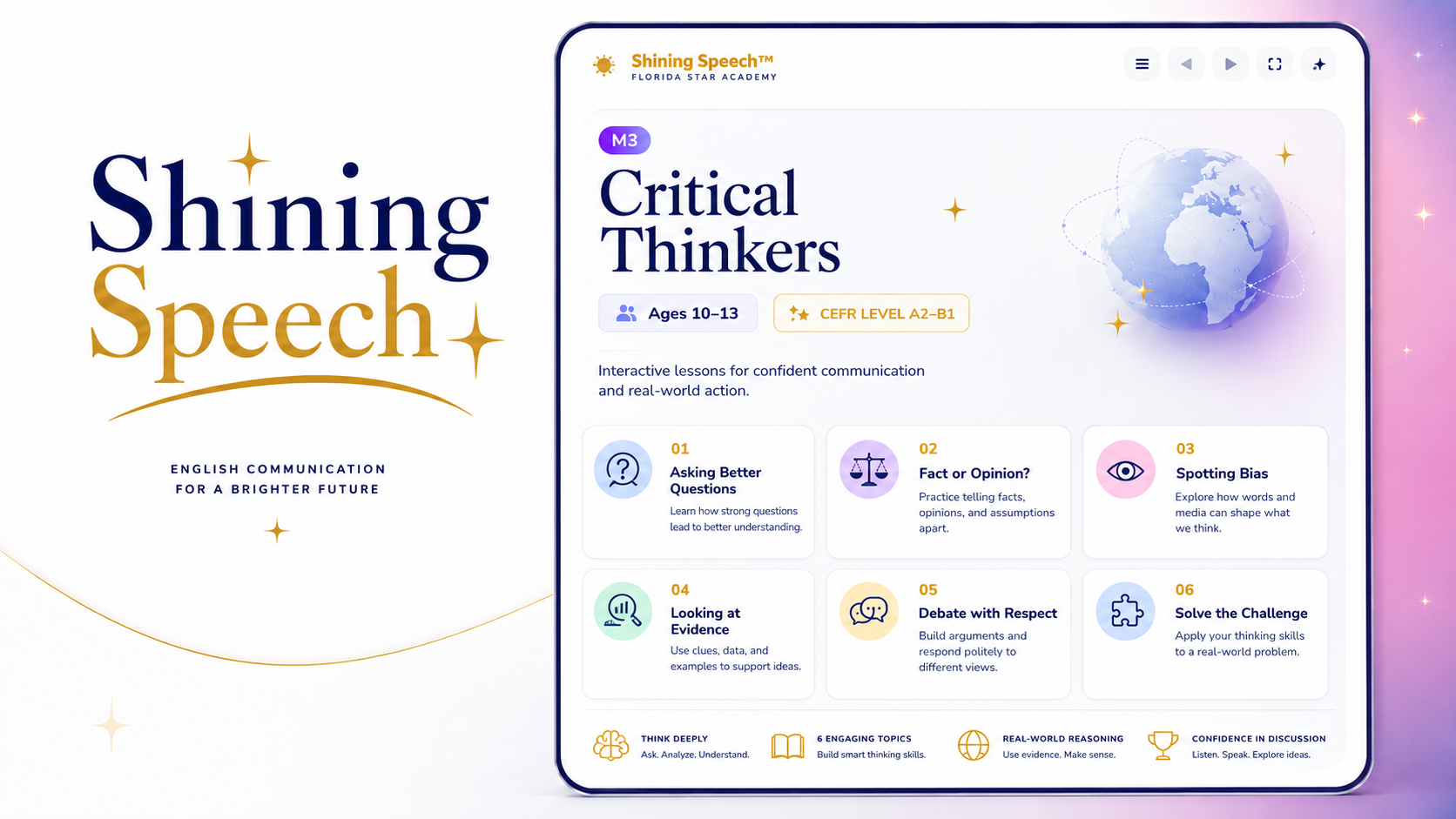
Most communication programs teach children what to say. Shining Speech teaches them how to exist in a room — with clarity, confidence, and the ability to be heard. One integrated educational model for public speech, not four separate classes bolted together.
Ages 4-17
Florida-Based
Research-Backed
ESL + ELA + Speaking + Bilingual
Is Your Child Experiencing Any of These?
Knows the subject — struggles to express it.
Your child understands the material — but cannot organise thoughts, structure a response, and deliver it clearly under pressure. This is a communication skills gap, and it is completely teachable.
New to Florida, English is not their first language.
Your child arrived in a Florida classroom and went quiet. Standard ESL treats grammar. This program treats confidence.
Can speak at home — can't speak in a classroom or group.
In a group setting, something shuts down. This is not shyness. It is the absence of a structured child communication development program.
Florida schooling isn't addressing communication as a skill.
Florida's curriculum develops reading and maths. Communication — the ability to speak with clarity and participate with confidence — is assumed, not taught.
The 4 Pillars of the Shining Speech Educational Model
Pillar 1
Bilingual Advantage
Language as an Asset, Not a Barrier
For: Children navigating English as a second language or from bilingual family environments in Florida.
Develops: Cognitive flexibility, contextual awareness, communication range across two linguistic systems, and identity confidence in a multilingual environment.
Bilingual children who receive structured support — not correction — develop broader semantic range and stronger working memory.
Pillar 2
ESL — English as a Living Language
Fluency With Confidence, Not Just Correct Answers
For: Children for whom grammar-first approaches have created anxiety rather than fluency.
Develops: Spoken fluency, listening comprehension, conversational confidence, and the ability to communicate meaning effectively without paralysing fear of grammatical error.
Grammar supports communication — not the other way around. Children speak first, in safe conditions, and accuracy develops naturally.
Pillar 3
ELA — English Language Arts
Reading to Think, Writing to Clarify
For: All children aged 4-17 who need to develop the academic language infrastructure for structured thinking and expression.
Develops: Deep reading comprehension, written thought structure, academic vocabulary, and the cognitive frameworks that allow children to form and communicate complex ideas.
ELA is not separate from public speaking — it is the cognitive architecture that makes effective speaking possible.
Pillar 4
Public Speaking
Not Performance. Voice.
For: All children who need to develop the confidence to speak in front of others — from a child who won’t raise their hand to a teenager preparing for academic environments.
Develops: Physical presence, vocal delivery, eye contact, structured argument, debate skills, and the foundational belief that their voice is worth hearing.
Progression: 1:1 private then 1:2 semi-private then 1:5 small group — each stage introduced only when the child is genuinely ready.

A Communication Skills Program That Treats Voice as a Development Outcome
Why choose us
Why This Florida Communication Skills Program Is Different
01
Integrated, not modular.
Every other communication skills program in Florida offers its components separately. Shining Speech is the only program that delivers all four as one integrated educational model — because communication development only works when every pillar is reinforcing every other.
02
Research-backed, not borrowed.
The Shining Speech educational model was developed by the Florida Institute for Academic Leadership through original research into bilingualism, relocation, language anxiety, and child communication development. It is a proprietary, trademark-registered methodology — not an adapted school curriculum.
03
Designed for Florida's actual children.
Florida is home to one of the largest immigrant and relocating child populations in the United States. This child communication development program was built around that specific reality — not adapted from a British ESL curriculum or a generic American public speaking workshop.
04
Modern, not traditional.
Traditional educational models reward silence. They correct before they build confidence. The Shining Speech model inverts this: trust before pressure. Expression before perfection. Participation as the metric that matters.
Frequently Asked Questions
What is a Florida educational model for public speech?
A Florida educational model for public speech is a structured, research-grounded curriculum that develops a child’s ability to communicate clearly, speak with confidence, and express ideas effectively. The Shining Speech model integrates bilingual support, ESL, English Language Arts, and progressive public speaking development into one coherent program, designed specifically for the linguistic and cultural diversity of Florida’s child population. Available in-person and online for children aged 4-17.
How is this different from a standard ESL program in Florida?
Is this program only for bilingual or immigrant children in Florida?
No. While the Shining Speech educational model was developed with the specific needs of bilingual, relocating, and transitioning children in mind, the program is designed for all children aged 4-17 who need structured communication development. Monolingual English-speaking children who struggle with public speaking, classroom participation, or verbal expression benefit from the same model.
What ages does the child communication development program in Florida accept?
Shining Speech accepts children from age 4 through age 17. The program is structured around developmental readiness rather than rigid age cohorts — every child begins in 1:1 private sessions and progresses to 1:2 and small group formats when individually assessed as ready. The Florida Institute for Academic Leadership recommends early enrollment where possible, as communication habits established between ages 4 and 8 provide the strongest developmental foundation.
How do I enroll my child in the Florida educational model program?
Florida Educational Model for Public Speech — What Makes It Work
Communication is consistently identified as one of the most critical skills for academic success, professional achievement, and social confidence — and yet it is one of the skills least explicitly taught in Florida’s standard educational framework. Children are expected to develop it as a by-product of learning other things.
A Florida educational model for public speech exists to close that gap systematically. Not by adding a speaking component to an existing curriculum, but by treating communication itself as the curriculum — and building every other academic skill in service of it.
What an effective educational model for public speech actually includes
An effective educational model for public speech builds four things, in order: the safety to speak without fear of judgment, the language infrastructure to have something meaningful to say, the structure to organise and deliver that meaning coherently, and the repeated experience of being heard — starting with one trusted adult, progressing to a peer, and eventually to a small, fully trusted group.
This is the architecture of the Shining Speech communication skills program. Every component — bilingual support, ESL fluency development, ELA reading and writing, and progressive public speaking experience — exists in service of one outcome: a child who can communicate with confidence in any environment they enter.
Why Florida children specifically need this program
Florida’s educational landscape is one of the most linguistically and culturally diverse in the United States. More than 300,000 Florida students are classified as English Language Learners — a number that does not account for the much larger population of children who are bilingual, partially bilingual, or in the process of transition following relocation.
For these children, a standard Florida communication skills program designed for a child who arrived in the system speaking English in a culturally familiar environment is not an appropriate match. Silence is not personality. It is a neurological response to environmental mismatch, and it requires an environmentally designed response.
What results parents and children experience
The outcomes of a well-designed educational model for public speech are not visible primarily on a stage. They are visible in the classroom when a child participates in a group discussion for the first time in months. In the family dinner table conversation that used to be one-sided. In the school group project where a previously silent child begins to contribute.
Communication development is cumulative. The earlier it is addressed with a structured, research-grounded program, the more deeply it compounds. A child who develops confident communication at 6 does not simply become a child who can give a speech. They become an adult who asks questions, argues positions, and navigates every environment with a fundamental belief that their voice is worth the air it takes.
Your Child's Communication Development Starts Here
The gap between a child who communicates and a child who stays quiet is not intelligence. It is not language ability. It is the presence or absence of the right environment — built deliberately, sequenced correctly, and delivered by people who understand what communication development actually requires.
That environment is what Shining Speech builds. Session by session. Pillar by pillar. At the pace of your child — never rushed, never forced, always earned.