Some children know more English than they are willing to say.
A warm, structured speaking experience for ages 4–17. Teacher first. Buddy only when useful. Confidence grows through live conversation, clear routines and a pace the child can actually use.


A modern curriculum with clear academic reference points.
Families see a communication journey designed for practical school use. Language development is CEFR-referenced, while academic language and literacy design are informed by CPALMS standards resources.
The curriculum is prepared specifically for live international communication, from early speaking confidence through academic, research and leadership communication.
CEFR is used as an international reference point for language development and communication expectations.
CPALMS standards resources inform age-appropriate academic language, literacy and communication design.
For many families, the challenge is not another grammar point. It is the gap between what the child understands and what they can confidently express in front of another person.
English is not always the whole problem.
Shining Speech™ is for children who need more opportunities to use their voice. That can include children learning English, children already speaking it well and children whose confidence changed after a move, school transition or social change.
Your child understands, but disappears when the room gets louder.
They know more than one language but hesitate to use English spontaneously.
A new country, school or classroom culture changed how safe speaking feels.
They know the material but freeze when attention turns toward them.
Apps and worksheets are not creating enough live speaking turns.
They already speak well and want stronger discussion, presentation and leadership communication.
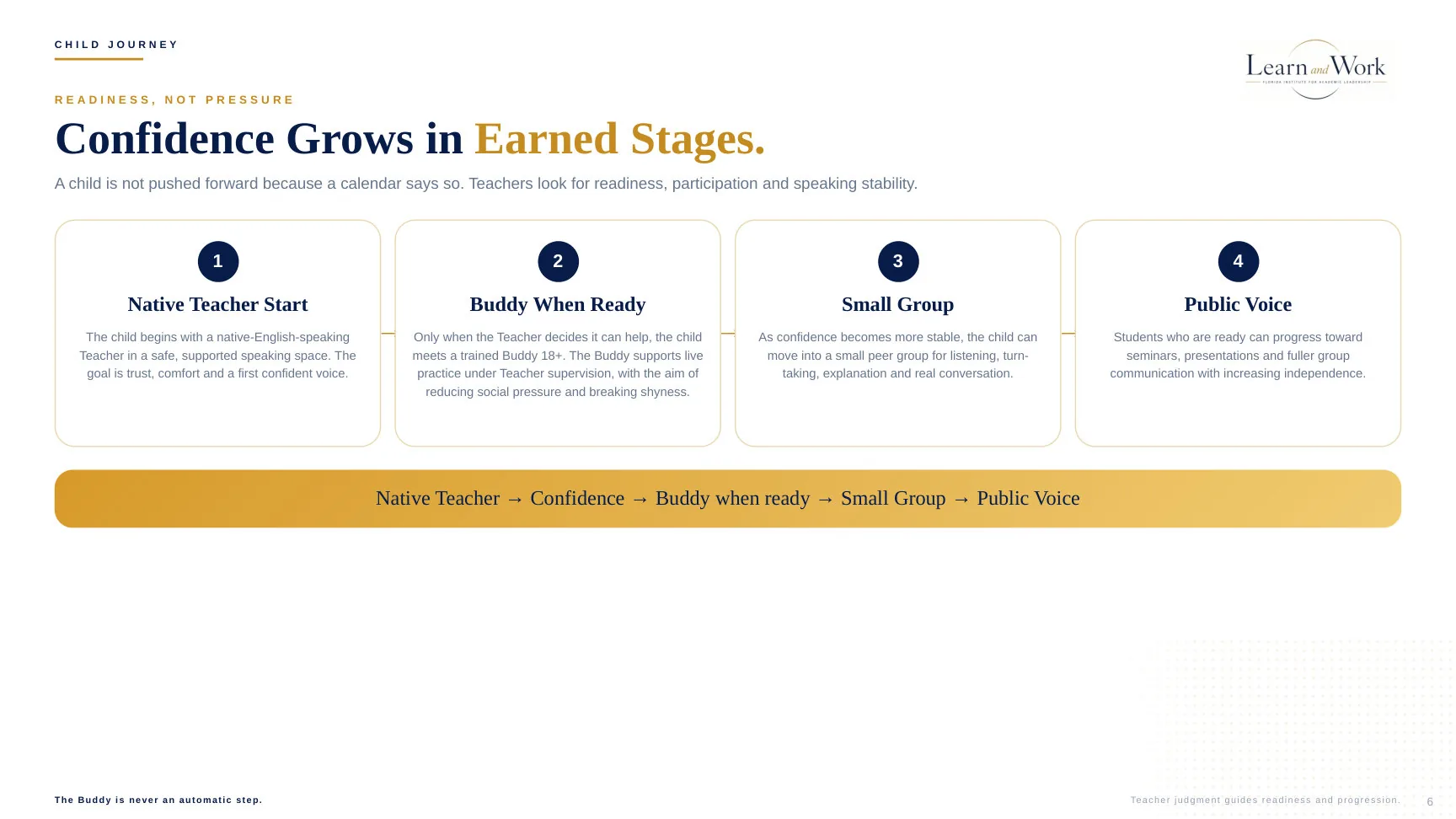
Confidence grows in earned stages.
A child is not moved forward because a calendar says so. The Teacher looks at participation, speaking stability, language needs and group fit.
Two trial lessons before the longer commitment.
The trial gives the child time to meet the learning environment and gives the Teacher a chance to understand how the learner responds in a live session.
A lesson, not an audition.
- Meet the Teacher in a low-pressure setting
- Try the Shining Speech™ lesson rhythm
- Have time to think before answering
- Experience live conversation without being rushed
Fit before pressure.
- Grammar and language profile
- Speaking fluency and spontaneous response
- Confidence in speaking
- Starting format and support needs
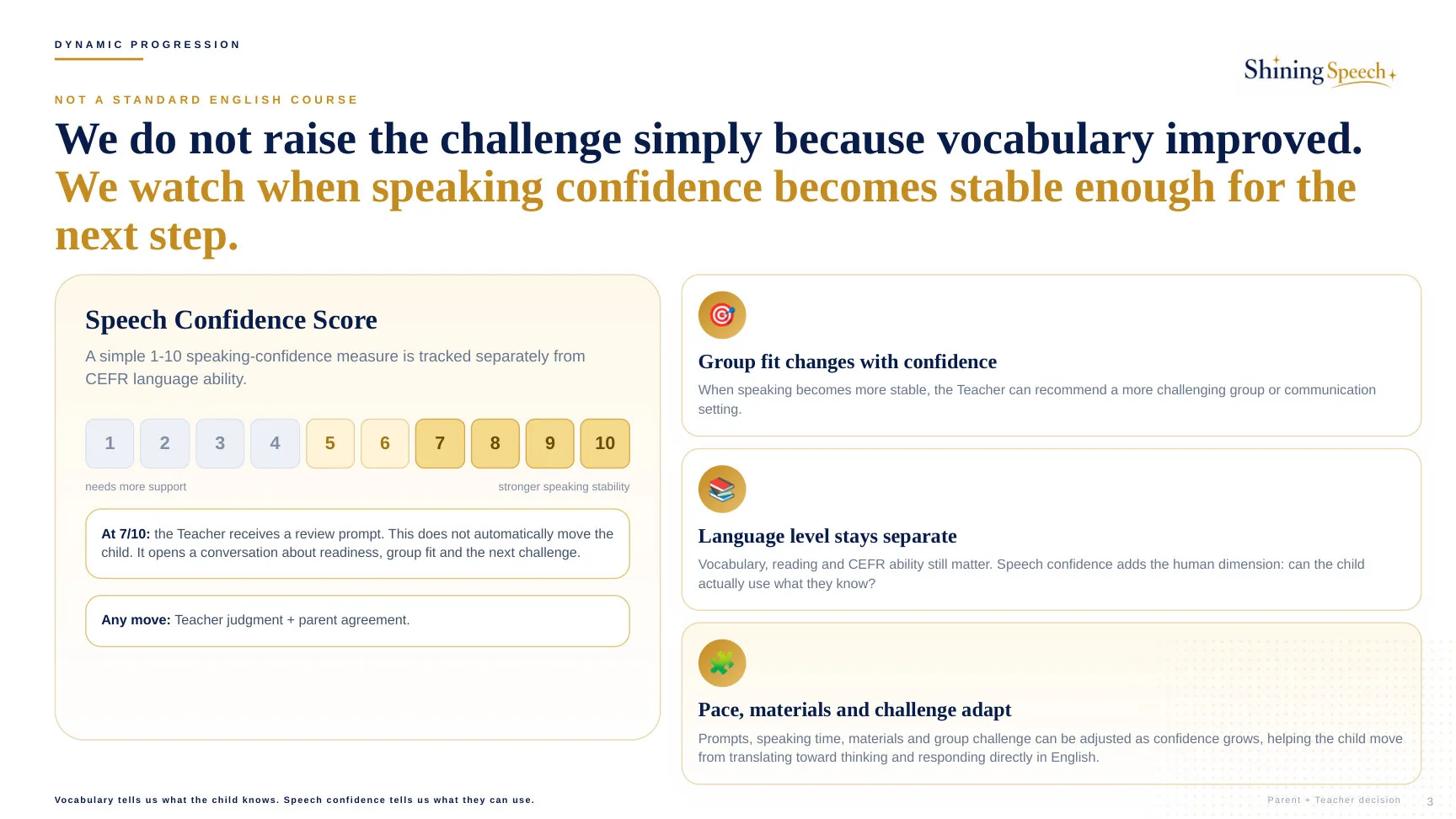
Vocabulary tells us what a child knows. Confidence tells us what they can use.
The 1–10 Speech Confidence Score is separate from CEFR or language ability. At 7/10 the platform can prompt the Teacher to review readiness. It is not an automatic promotion.
Any meaningful move remains a Teacher decision with parent agreement.
Different ages need different reasons to speak.
Topics, visuals, pacing and social challenge change over time. The central goal stays the same: help the child participate, explain, present and lead with increasing confidence.
Sparkle Lab
Play, movement, listening, short speaking turns and positive participation.
Wonder Squad
Stories, reading, speaking, explaining and first presentation habits.
The Think Tank
Opinions, reasons, discussion, collaboration and debate.
Global Spotlight
Academic discussion, media, leadership and public speaking.
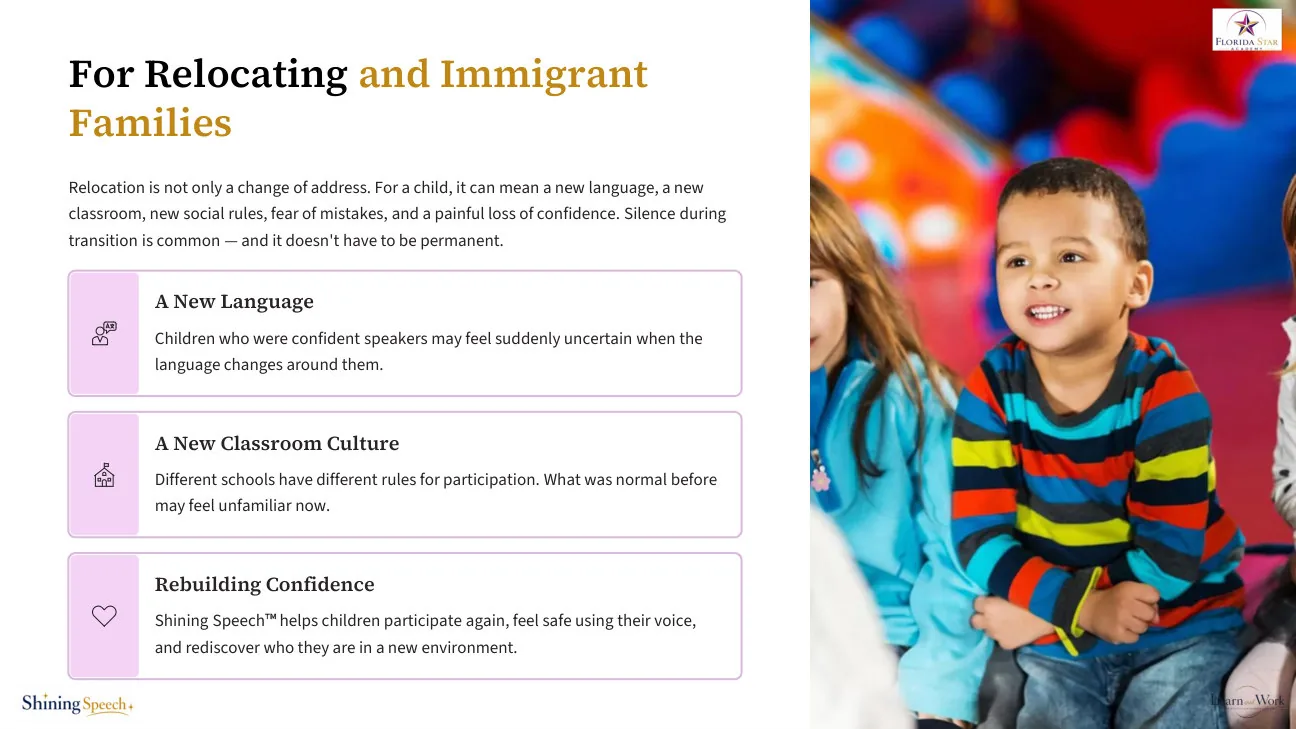
A move can change confidence before it changes language ability.
A new country, new school and new classroom culture can make a child suddenly cautious. The goal is not to label that hesitation. It is to give the child repeated, structured chances to participate again.
- Practice everyday English in a familiar session structure
- Rebuild comfort speaking with someone new
- Move from one-to-one safety toward peer conversation when ready
- Develop presentation and classroom communication without clinical framing
The child should know who is doing what.
Safety is designed into roles, supervision and access rather than turned into frightening copy. Parents should understand the boundaries without needing to read a compliance manual.
Professional oversight
- Observes progress and group fit
- Controls educational decisions
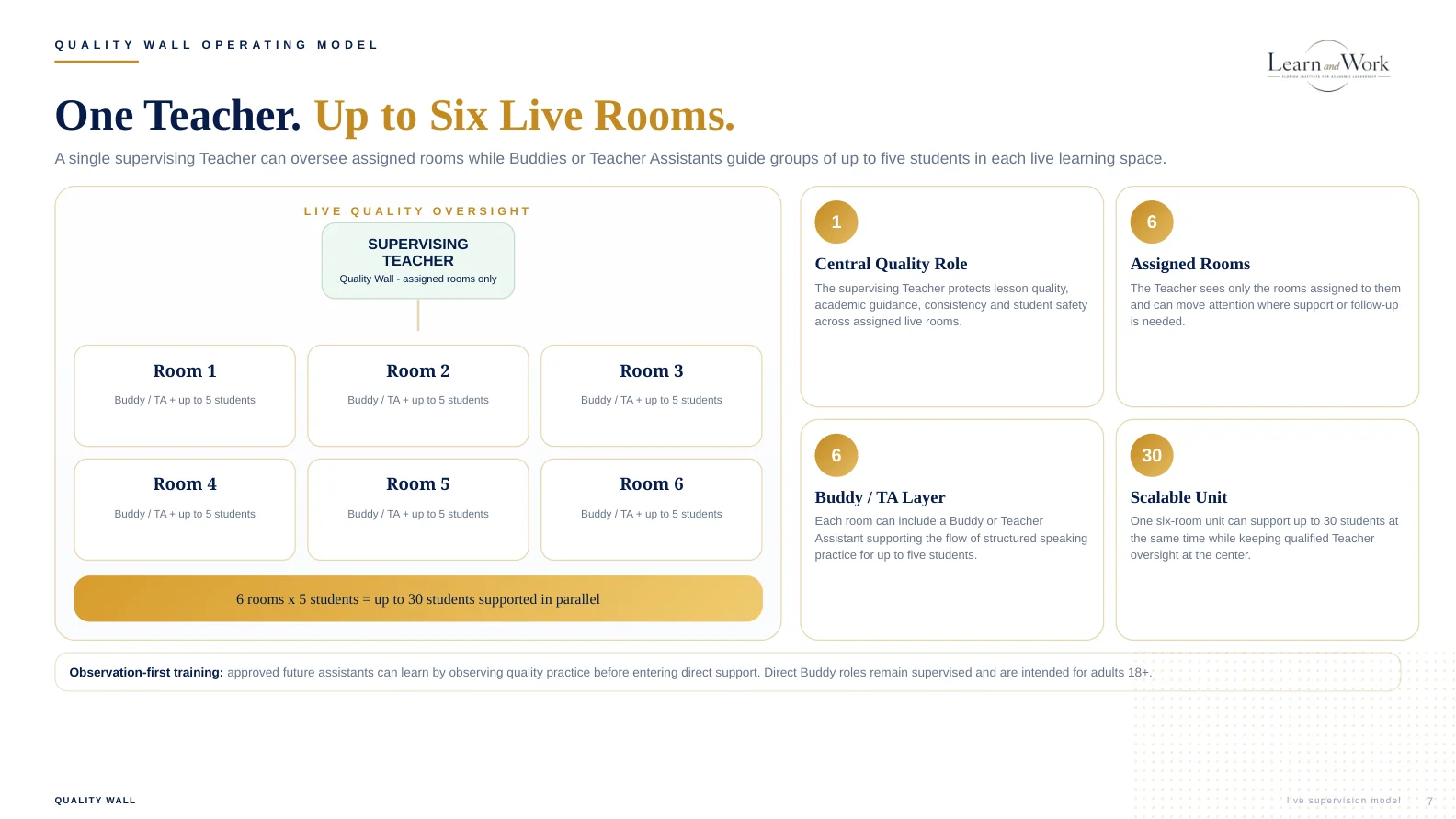
- Supports Buddies
- Can observe assigned rooms live
- Provides parent-facing feedback
Structured speaking practice
- Works within prepared lesson scenarios
- Uses Care and Quality guidance
- Does not grade or change levels
- Does not replace the Teacher
- Works within defined safeguarding expectations
Simple current pricing.
The latest registration flow lists two sessions per week, eight sessions per month, at $69 per live session.
Current public pricing can change. The registration page and applicable terms govern the final purchase.
The questions we would ask if this were our child.
Clear answers matter more than dramatic promises.
Does my child start with a Buddy?
No. The current family framework emphasizes Teacher first. A Buddy can be introduced later when the Teacher believes it is appropriate and useful.
Can a Buddy change my child’s level?
No. Buddies do not independently grade or move a student. The Teacher remains responsible for educational decisions.
What if my child is already fluent?
Fluent learners can use the program to develop public speaking, discussion, critical thinking, explanation and leadership communication.
Is this for children with medical or psychological issues?
The program is not therapy, diagnosis or clinical treatment. Families with health concerns should consult qualified health professionals.
What if my child needs more time to answer?
Care guidance encourages pacing, rephrasing, lower-pressure prompts and safe re-entry so the learner has a better chance to participate without being rushed.
How do we begin?
Use the current registration flow for the two trial lessons or the monthly plan. The first sessions help the Teacher understand the learner’s starting point.
The classroom remains local. The communication team can be hybrid.
For EU school sessions, the class stays physically at its own school with at least one local Teacher in the room. A Buddy and Master Quality Teacher can join from a Partner college / school hub or live online, while staying in the same lesson and live supervision structure.
For a parent, the important idea is simple: the child remains inside a school environment with a Teacher physically present. International communication is added around that classroom, not substituted for it.
- Up to 30 learners can remain together in the school classroom
- At least 1 local Teacher is physically present
- Buddy · 18+ can be on-site at a Partner hub or online
- Master Quality Teacher can supervise on-site or remotely
- EU institutional school block: 25 minutes
Conversation practice can carry several skills at once.
Shining Speech™ uses English as the medium, but the live tasks also ask the child to listen, organize an idea, explain a reason, react to another person and gradually hold an audience.
Move from private understanding into spoken language.
Reasons, examples, evidence and age-appropriate critical thinking.
Practice listening, turn-taking and responding when attention shifts toward you.
Older learners can move toward discussion, presentation and seminar roles when ready.
Choose a program for your child. Help create opportunity around your child, too.
Shining Speech™ is designed as more than a lesson transaction. The same system that gives a child more room to speak can also create supervised development opportunities for young adults in participating communities.
Your child grows inside a wider learning community.
When families choose a program built around qualified Teacher oversight and trained Buddy pathways, they help sustain demand for a model in which young adults can learn responsibility, communication, mentoring and educational professionalism under supervision.
Those young adults can then carry stronger communication and leadership habits back into their schools, workplaces, families and local communities.
More opportunities to answer, explain, discuss and gradually use a public voice.
Adults 18+ learn inside clear boundaries, with training and Teacher oversight rather than being dropped into a classroom alone.
Teacher expertise is not replaced. It becomes the quality center for students and developing facilitators.
Communication, reliability and leadership developed in one setting can become useful capacity in schools, families, organizations and future workplaces.
If your school or college is an approved Partner with active local onboarding, eligible Buddy candidates may be able to complete orientation, observation and training through their own institution instead of starting from a distant pathway.
The child stays in a real classroom with a Teacher physically present.
In the EU school format, the learner group remains at its own school. At least one local Teacher is physically in the classroom. The Buddy and Master Quality Teacher may join from the same Partner school / college hub or online, but the session remains one supervised live learning experience.
Local classroom first
The school Teacher remains with the children and keeps the local classroom context intact.
International speaking layer
The Buddy adds structured live communication without replacing the Teacher or the school.
Quality around the session
The Master Quality Teacher can supervise remotely or on-site and support the Buddy when the session needs help.
Short enough for focus. Structured enough for progress.
The same five-part rhythm moves learners from curiosity into live speaking, explanation and a clear final output.
Need more than the compact school format?
The 25-minute version is designed to fit school schedules. Florida Star Academy is the family-facing route for a longer 45-minute individual session with more room for one-to-one conversation, feedback, repetition and extension.
Your child does not need to prove anything on day one.
They need a room where speaking has enough time to become possible.