Shining Speech™ · Program

Knowing English is one thing.
Using your voice when the room is listening is another.

A live communication program for children and teens ages 4–17 combining English speaking, ELA-related communication, public speaking, critical thinking, emotional awareness and live human interaction.

Ages 4–17Live Teacher SupervisionHuman-first, technology-supportedCEFR-referenced · CPALMS-informed
Students in a live international conversation with a teacher on screen
Students in a live international conversation setting with a teacher on screen
Shining Speech™ program overview: what a live lesson is designed to do.
CURRICULUM REFERENCE FRAMEWORK

School practice first. International references built around it.

Shining Speech™ is a purpose-designed communication curriculum developed for day-to-day use with children, Teachers, Buddies and Partner Schools. Its learning architecture is informed by the practical realities of the school day, then mapped against established language and academic reference points.

CEFR-REFERENCED

Language development with an international reference point.

CEFR supports the language-proficiency reference layer of the program. It helps distinguish language knowledge from the separate Speech Confidence Score and supports age-appropriate expectations as learners move toward more independent academic communication.

CPALMS-INFORMED

Academic communication connected to Florida standards resources.

CPALMS standards resources are used as an academic reference point when shaping literacy, reasoning, ELA-related communication, research, presentation and school-ready communication tasks.

Reference does not mean endorsement. CEFR and CPALMS are used as curriculum reference resources. This wording does not claim government approval, accreditation or endorsement by the Council of Europe, the Florida Department of Education or CPALMS.
PURPOSE-DESIGNED FOR MODERN SCHOOL USEBuilt from day-to-day school practice and operational experience.

The curriculum is prepared specifically for live international communication, from early speaking confidence through academic, research and leadership communication.

CEFRLanguage progression reference

CEFR is used as an international reference point for language development and communication expectations.

CPALMSFlorida academic reference

CPALMS standards resources inform age-appropriate academic language, literacy and communication design.

We are not building another English course. We are building the distance between knowing and being heard.

The program is designed around a simple reality: a child may understand English, know the answer and still hesitate when another person is waiting for a response. Shining Speech™ gives that child structured reasons to think, speak, explain, present and lead.

4–17age range
4age pathways
96lessons per year in each age-level framework
Livehuman speaking practice
ONE LEARNING JOURNEY

Five skills grow together.

Language matters. So does the ability to use it in front of another human being. The curriculum deliberately connects English with literacy, explanation, audience awareness, reasoning and confidence-building communication.

A

English Speaking

Fluency, vocabulary, pronunciation, natural phrasing and spontaneous conversation.

B

ELA & Literacy

Reading, meaning, storytelling, explanation and age-appropriate language development.

C

Public Speaking

From a safe first voice to discussion, presentation and audience confidence.

D

Critical Thinking

Questions, reasons, evidence, opinions and the ability to explain or defend an idea.

E

Emotional Awareness

Pacing, micro-praise, safe re-entry and communication choices that reduce unnecessary pressure.

THE DEVELOPMENT ARC

Voice is built in stages.

The goal is not louder children. The goal is children who can use what they know when the moment asks for it.

01Knowing

Language, ideas and understanding are present.

→
02Speaking

The child begins using English in live exchange.

→
03Expressing

Answers become reasons, stories and opinions.

→
04Presenting

The child learns to hold attention and organize ideas.

→
05Leading

Communication becomes a tool for participation and leadership.

AGES 4–17

The same big goal. Different language for every age.

Age shapes topics, pacing, materials and social challenge. The framework grows from play into conversation, structured thinking, debate, presentation and leadership communication.

Play + first voice
4–7

Sparkle Lab

Movement, listening, short speaking turns, visual prompts and positive participation.

Conversation + stories
8–10

Wonder Squad

Sentences, stories, reading, explaining and first public-speaking habits.

Thinking + discussion
11–14

The Think Tank

Opinions, reasons, collaboration, debate and asking better questions.

Presence + leadership
14–17

Global Spotlight

Academic discussion, media, public speaking and confident global communication.

GLOBAL SPOTLIGHT · AGES 14–17

The program grows up with the student.

By the later years, Shining Speech™ moves beyond everyday fluency into academic communication, research, media literacy, innovation, leadership and professional communication. Students are still learning through speaking, but the questions, evidence and expected outputs become progressively more sophisticated.

Global Spotlight is the final developmental stage of the curriculum: four annual levels, each with 96 lessons. The standard structure remains short and focused, while the communication task develops from clear claims and inquiry into research, professional presentation, leadership and a final transition portfolio.

14–17four annual age levels
384Global Spotlight lessons
96lessons per age level
25 minstandard lesson format
AGE 14 · GLOBAL SPOTLIGHT 1 · B1+ → B2 REFERENCE

Academic Communication & Global Curiosity

Learn to make a point, support it, question it and present it clearly.

The first Global Spotlight year strengthens reasoning and academic habits through evidence-based explanations, inquiry, research, data literacy, teamwork and public speaking.

Clear claims & reasonsBetter questionsReliable sourcesCharts & graphsScience communicationConstructive feedbackResearch interviewsPodcast planningAudience skillsCuriosity showcase
AGE 15 · GLOBAL SPOTLIGHT 2 · B2 REFERENCE

Research, Media & Innovation

Move from consuming information to examining, organizing and communicating it.

Students work with research strategy, source quality, media and visual literacy, innovation, responsible technology, AI literacy, entrepreneurship and professional communication.

Search strategySource qualityFacts vs. inferenceHeadlines & contextVisual literacyAI as a learning toolDigital privacyEntrepreneurshipPitch structureProfessional emailCross-cultural communicationInnovation showcase
AGE 16 · GLOBAL SPOTLIGHT 3 · B2 → C1 REFERENCE

Leadership & Professional Communication

Use communication to lead a process, not simply answer a question.

The emphasis shifts toward facilitation, planning, problem solving, decision-making and the language students need for academic, project and early professional environments.

Leadership through listeningFacilitationMeeting agendas & minutesGoal settingRoot-cause questionsNegotiationNetworkingCV languageInterview storytellingResearch questionsPresenting dataProject proposalPeer coachingLeadership showcase
AGE 17 · GLOBAL SPOTLIGHT 4 · C1 REFERENCE

Capstone Voice & Transition

Prepare to communicate with greater independence across university, project and career contexts.

The final year brings together reasoning, research, writing, presentation and professional interaction through a capstone-oriented communication sequence and portfolio.

Audience analysisThesis & reasoningSynthesis across sourcesEditing for precisionExecutive summaryPresentation decksResearch planEvidence portfolioRisk planningCollaborative leadershipUniversity / career inquiryInterview panelQuestions under pressurePortfolio curation
Designed for school use: Global Spotlight uses neutral academic themes across research, media literacy, science, innovation, teamwork, leadership and professional communication. The curriculum does not require students to state political, ideological, religious or identity-based positions, and it does not require personal disclosure.
THE FOUR-YEAR ARC

From clear ideas to an independent academic and professional voice.

Each year raises the communication demand while keeping the same principle: students learn by thinking, speaking, listening, revising and presenting.

AGE 14Reason & explain

Claims, questions, sources, data and informative speaking.

AGE 15Research & create

Media literacy, innovation, digital skills, entrepreneurship and pitching.

AGE 16Lead & collaborate

Facilitation, planning, professional communication and project leadership.

AGE 17Synthesize & transition

Capstone research, formal presentation, portfolio and university/career communication.

INSIDE A SHINING SPEECH LESSON

The lesson is built. The human interaction stays alive.

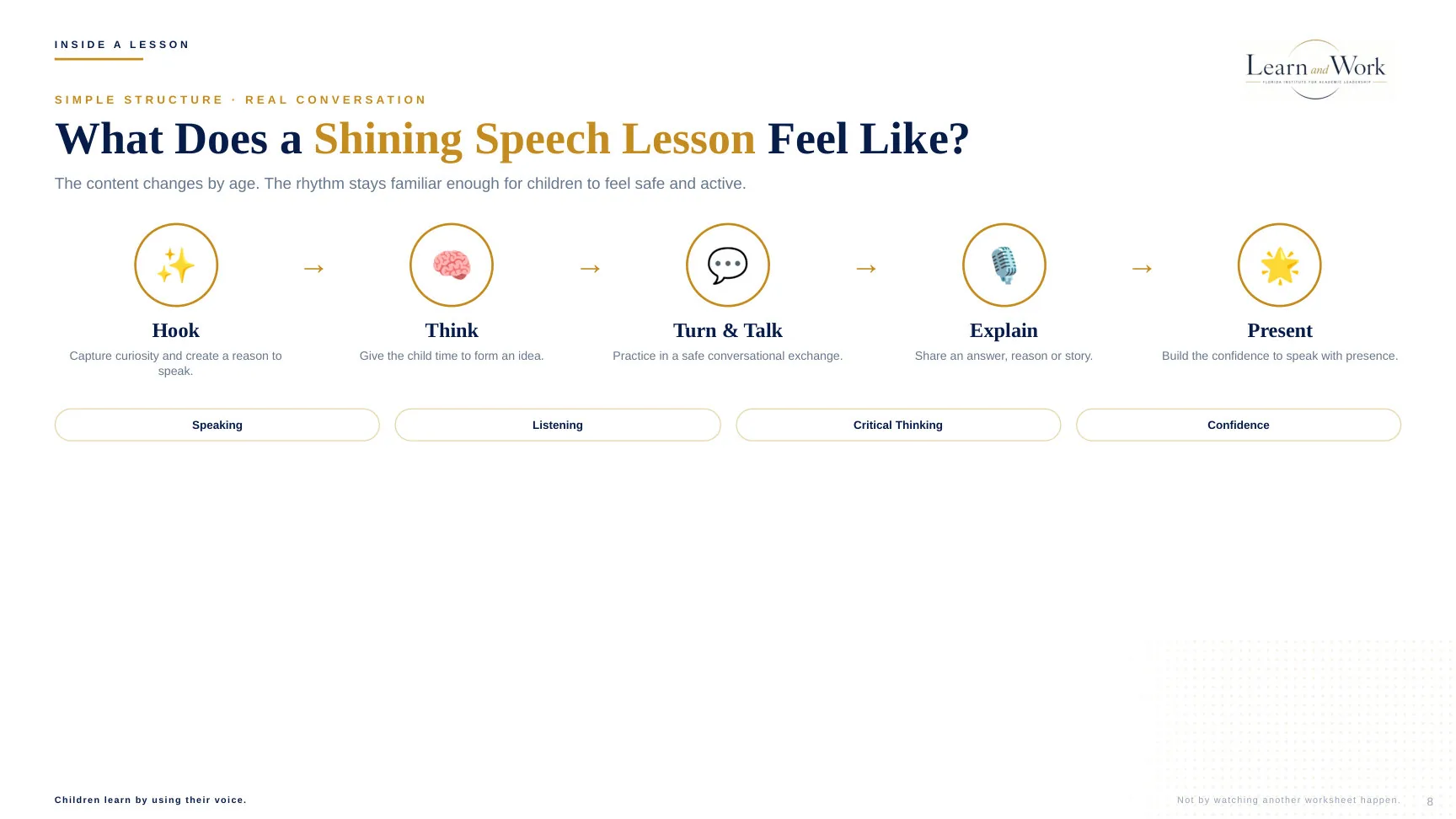
The content changes by age, but the rhythm stays familiar enough to create safety and momentum. Every lesson gives the learner a reason to speak and the adult clear guidance on how to help the conversation move forward.

1HookCreate curiosity and a reason to speak.
2ThinkGive the learner time to form an idea.
3Turn & TalkMove into a safe live exchange.
4ExplainAsk for a reason, example or story.
5PresentBuild voice, presence and confidence.
Shining Speech lesson flow showing Hook, Think, Turn and Talk, Explain and Present
practical Shining Speech™ parent material: lesson rhythm.
STANDARD LIVE LESSON25 minutes

A short lesson does not mean a rushed lesson. The structure is deliberately tight: curiosity first, thinking space second, then increasingly independent speaking. The exact balance changes with age, topic and learner readiness, while the communication rhythm stays recognizable.

0–4 MIN01Hook & ConnectWelcome, activate prior knowledge and give the learner an immediate reason to join the conversation.
4–7 MIN02Think & PrepareIntroduce the key idea, vocabulary or visual cue and give the learner time to build an answer.
7–14 MIN03Turn & TalkMove into live exchange, questions, guided practice and repeated speaking turns with Teacher or Buddy support.
14–20 MIN04Explain & ExtendAsk for a reason, example, comparison, story or evidence. The learner makes the message clearer and more independent.
20–25 MIN05Present & ReflectFinish with a short spoken output, feedback and one clear takeaway for the next session.
Ages 4–7

More movement, play, visual prompts and healthy humor. The goal is to make speaking feel worth returning to.

Ages 8–10

More structured language and explanation while preserving warmth and curiosity.

Ages 11–14

More discussion and presentation while preserving warmth and curiosity.

Ages 14–17

More academic communication, evidence, research, media literacy, leadership and professional speaking.

The published master curriculum uses 25-minute lessons. Individual lesson timing can flex slightly inside the same structure when a Teacher needs to protect comprehension, participation or quality.
Teacher Notes

What to ask, extend or simplify.

Care Notes

How to support pacing, confidence and safe re-entry.

Quality Notes

What to notice and follow up.

Buddy Scenario

Clear guidance when a Buddy is involved.

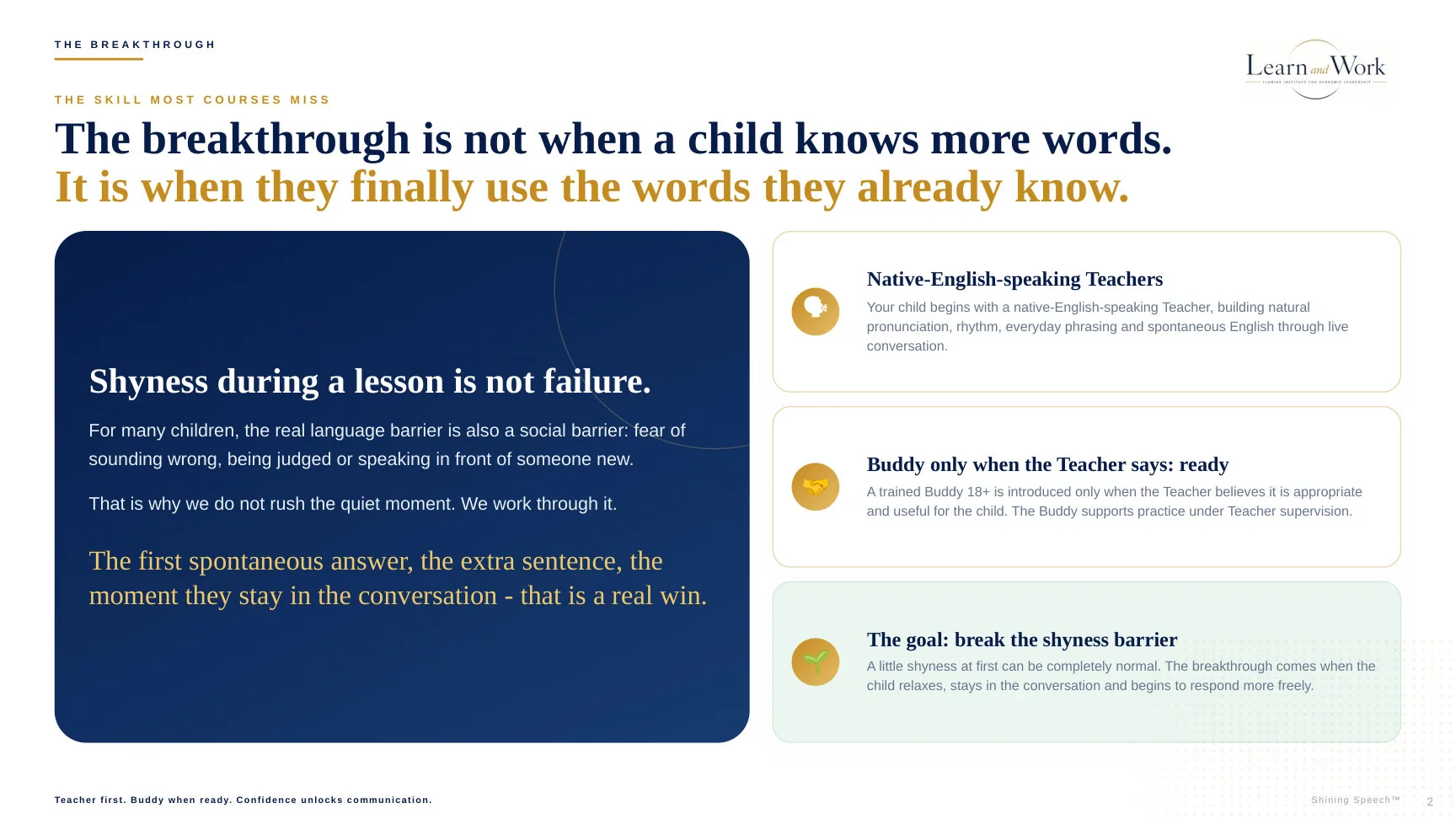
Parent guide page about the speaking breakthrough and Teacher-first approach
practical Shining Speech™ parent material: confidence before pressure.
CARE WITHOUT CLINICAL LANGUAGE

Sometimes the most useful thing an adult can do is wait three more seconds.

Care is built into the lesson as communication guidance, not diagnosis or therapy. A child may need a slower prompt, a smaller audience, a different question, a moment to think or a way back into the conversation after hesitation.

Supportive does not mean lowering expectations. It means lowering unnecessary pressure so the child can actually reach them.

  • Adjust pace without making the child feel singled out
  • Rephrase rather than repeat pressure
  • Use micro-praise for participation, not perfection
  • Allow confidence to grow before increasing social challenge
READINESS, NOT PRESSURE

Progression follows speaking stability.

Larger groups are not a prize. They are simply another communication setting when the child is ready for it. Educational decisions remain with the Teacher, with parent involvement in meaningful progression changes.

1

1:1

Private confidence and Teacher observation.

2

1:2

A second voice when the child is ready.

3

Small Group

Turn-taking, listening, explanation and peers.

4

Larger Discussion

More social challenge and audience awareness.

5

Seminar / Presentation

Public voice when readiness supports it.

SPEECH CONFIDENCE SCORE

1–10 measures speaking confidence only.

12345678910

At 7/10 the Teacher receives a review prompt. This does not automatically move the learner. It opens a professional review of readiness and group fit.

Language level stays separate.

Grammar, vocabulary, reading and CEFR-aligned language ability answer a different question from speaking confidence.

  • Language: what does the learner know?
  • Confidence: what can the learner use in a live room?
  • Movement: Teacher judgment + parent agreement, not an automatic algorithm.
TEACHER + BUDDY

One protects the quality. One multiplies the conversation.

A Buddy is an adult 18+ communication partner/facilitator working within the Shining Speech™ framework and under Teacher supervision where applicable. The Buddy does not replace the Teacher and does not independently grade, change levels or make formal educational decisions.

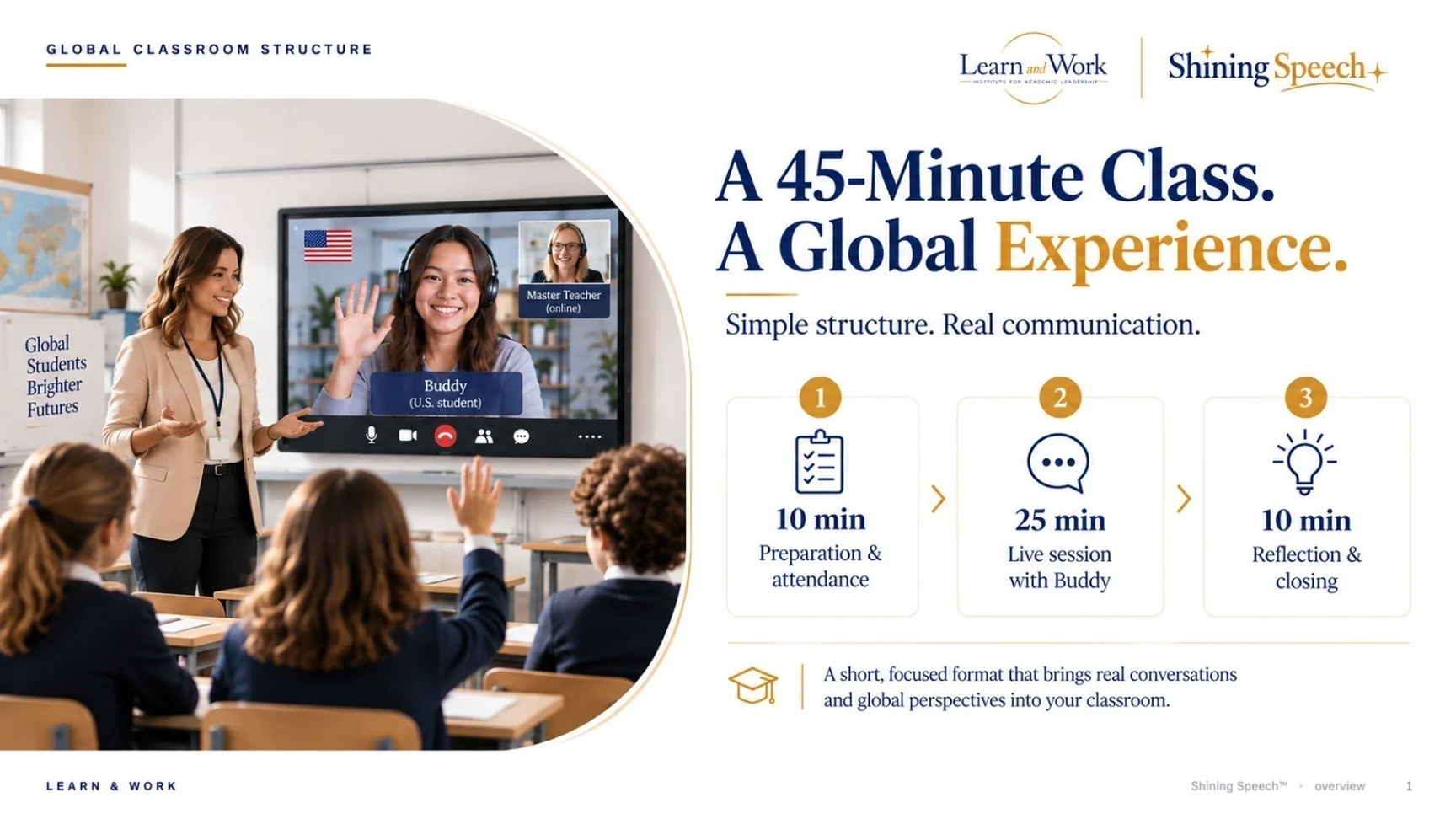
A 45-minute class: 10 minutes preparation and attendance, 25 minutes live session with a Buddy, 10 minutes reflection and closing
Global classroom structure: a 45-minute class built around a 25-minute live session with a Buddy.
Teacher

Academic authority

  • Observes, evaluates and protects quality
  • Supports Buddies and student progress
  • Makes educational decisions
  • Can enter or support assigned rooms live
Buddy · 18+

Conversation layer

  • Follows prepared Lesson Scenarios
  • Uses Care and Quality guidance
  • Creates additional speaking turns
  • Works inside defined role boundaries
ONE CURRICULUM · MULTIPLE DELIVERY FORMATS

Hybrid school delivery and higher-touch exclusive formats.

The curriculum remains connected while staffing and scheduling adapt to the setting. EU Partner schools can use a 25-minute live classroom block; the master curriculum documentation may still show the 25-minute standard lesson architecture.

EU Hybrid Classroom

Up to 30 learners remain physically together at school with at least one local Teacher in the room. One Buddy and one Master Quality Teacher can be on-site at a Partner hub or live online.

Small Group / Cohort

Up to three instructional roles can connect around one exclusive live experience. Groups of up to five can use two educator roles; a full 30-learner exclusive cohort can use six direct group roles plus one Master Quality Teacher.

Teacher and Buddy roles remain distinct. Live supervision is part of the delivery structure, and exact staffing depends on Partner arrangement, qualifications, safeguarding requirements and the approved format.
25 MINUTES OR 45 MINUTES?

The school lesson is intentionally compact. The individual lesson gives one learner more room.

The 25-minute session is the shortened school format: focused, repeatable and designed to fit real timetables. Families who want a longer 1:1 session can choose a 45-minute individual experience through Florida Star Academy.

25 min

School format

Compact live communication built for classrooms, partner schools and repeated speaking practice inside the school day, and for children 4–7 years old.

For Schools
45 min

Florida Star Academy · Individual

More time for one-to-one conversation, feedback, repetition, extension and individual pacing. Individual sessions for children 8+ years old.

Explore 45-Minute Sessions
QUESTIONS

What families and schools usually want to understand first.

Clear roles, honest expectations and a human-first experience are part of the design.

Is Shining Speech™ therapy?

No. It is an educational communication and speaking-practice program. It does not diagnose or treat medical, psychological or speech conditions.

Does a Buddy replace the Teacher?

No. The Teacher remains responsible for professional oversight and educational decisions. The Buddy expands structured speaking practice within defined boundaries.

Is the confidence score an academic grade?

No. The 1–10 score refers only to confidence in speaking. Language ability and CEFR-related measures remain separate.

Does every child move into a group?

No. Group size changes when the Teacher believes the child is ready, with parent involvement in important progression decisions.

Is the program only for ESL learners?

No. It can serve ESL and bilingual learners, relocating students, quiet communicators and fluent speakers who want stronger public-speaking and leadership communication.

What role does technology play?

Scheduling, role-based access, lesson materials and supervision tools support the experience. The learning itself still depends on the learner thinking, speaking, listening and responding to people.

WHAT THIS ADDS TO THE LEARNING EXPERIENCE

Smaller rooms change more than the headcount.

The educational value comes from how the roles, materials and live interaction work together.

01

More possible speaking turns

Groups of up to five create more opportunities to answer, ask, explain and react than a single whole-class discussion can usually provide.

02

A lower social threshold

For some learners, speaking to four peers is a more approachable next step than speaking to a full class.

03

One shared academic direction

All rooms can work from the same Shining Speech™ lesson, prompts, Care Notes and Quality Notes.

04

Teacher authority stays visible

The Teacher remains responsible for educational decisions, confidence review and meaningful progression changes.

05

Adults learn too

Approved Buddies can develop communication, reliability, mentoring habits and international experience inside a supervised structure.

06

Technology organizes, people teach

Calendar, role access, Quality Wall and reporting support the interaction rather than becoming the lesson itself.

HYBRID SCHOOL MODEL · LOCAL CLASSROOM + INTERNATIONAL TEAM

The class stays in school. The international team can be in the room or live online.

Up to 30 learners remain physically together at their Partner school, with at least one local Teacher physically present in the classroom. The Buddy and Master Quality Teacher can participate on-site from a school or college hub, or join live online from another location. Either way, everyone works inside the same live session, lesson structure and supervision chain.

25-MINUTE EU SCHOOL CLASSROOM · HYBRID

Local teaching stays in the room. International communication is added around it.

The Partner school keeps its classroom, its Teacher and its educational authority. A Buddy adds the live communication layer, while a Master Quality Teacher supports quality, coaching and intervention. The two international roles may be physically together at a Partner college or school, or connected remotely.

30learners remain in their school classroom
1+local Teacher physically present with the class
2Buddy + Master Quality Teacher, on-site or online
1
Local classroom TeacherIs physically present with the class, knows the learners and remains the local educational authority.
2
Buddy · 18+Creates structured speaking turns and can connect from a Partner school / college hub or remotely, following the prepared lesson framework.
3
Master Quality TeacherSupervises the session, coaches the Buddy, protects delivery quality and can join directly when support is needed. The role can be on-site or remote.
EXCLUSIVE / HIGHER-TOUCH FORMAT

The same network can place more educators around smaller groups.

Exclusive delivery can connect up to three instructional roles around one live experience. A group of up to five can work with two educators, while a fully staffed 30-learner exclusive cohort can use six direct group roles plus one Master Quality Teacher.

3instructional roles can be live around one exclusive session
2 : 5educator roles for a group of up to five
7 : 30educational roles at full 30-learner cohort scale
3
Exclusive live teamDirect instruction, communication support and quality supervision can be connected at the same time.
2
Group of up to fiveTwo educator roles create more speaking turns, feedback and follow-up around a small group.
7
Full cohort of up to thirtySix direct group roles plus one Master Quality Teacher can support the full exclusive cohort structure.
ON-SITE PARTNER HUB
Several Buddies can work from the same school or college.

A Partner institution can seat trained Buddies together in one physical training / delivery room while they connect live to international learners.

↔
REMOTE DELIVERY
The same team can work from different locations.

Buddy and Master Quality Teacher can connect online while the learner group remains physically at school, preserving the same live contact and role structure.

BUDDY TRAINING · TRIAL WINDOW

Five trainees can learn the same session together.

Training trials mirror the live model. Up to five Buddy candidates can join one supervised training window with a professional instructor. The instructor models the 1:1 session flow, then trainees rotate through practice, observation and feedback before direct learner work.

500-HOUR DEVELOPMENT PATHWAY

Experience is built before higher-responsibility roles.

After initial training, 500 completed supervised / delivered program hours is the experience threshold for internal pathway review toward Master Teacher / Master Quality responsibilities. At 25 hours per week, 500 hours is approximately 20 weeks. Any role that requires formal teaching qualifications, licensing, safeguarding approval or Partner authorization still requires those conditions.

FLORIDA ↔ CENTRAL EUROPE

A useful transatlantic learning window.

South Florida (Eastern Time) is typically six hours behind Central Europe. That places 8:00 AM Florida at about 2:00 PM Central Europe and 3:00 PM Florida at about 9:00 PM. School partnerships can use a focused 3–5 hour Florida-morning window, while supervised individual sessions can extend across the broader Florida daytime / European after-school period.

Scheduling & role clarity: seasonal daylight-saving changeover weeks can temporarily shift the Florida–Central Europe difference by one hour, so the platform should schedule by time zone rather than fixed manual conversion. Buddy is an adult 18+ supervised communication role. The 500-hour threshold is an internal experience milestone, not an automatic teaching license, employment guarantee or automatic promotion.
MULTIDISCIPLINARY MASTER TEACHERS

The communication framework is designed to work with educators from many disciplines.

Shining Speech™ asks learners to reason, explain, question, compare, present and respond. For that reason, Master Teachers do not need to come only from English teaching. Licensed art, mathematics, science, literacy, elementary, physical-education and other educators can bring valuable professional perspective while working inside the same lesson, safeguarding and quality framework.

Subject expertise adds depth

Different disciplines bring different habits of explanation, evidence, creativity and presentation.

One quality framework

Teacher Notes, Care Notes, Quality Notes, lesson scenarios and live supervision keep the communication model consistent.

Master Teacher remains licensed

Eligibility depends on an applicable teaching / educator license and role requirements, not on being an English teacher specifically.

THE NEXT STEP

Give the child more than another worksheet. Give them a reason to use their voice.

Explore the family journey, see the Teacher + Buddy model or bring the framework into your school.