Class to class.
School to school.
System to system.
Learn & Work can provide the educational, digital and supervision infrastructure for a new kind of international exchange: one that begins with direct communication before it requires travel. Students speak with students. Teachers work with teachers. Schools build recurring relationships. Employers and public institutions can connect the learning pathway to local communities and local economies.
Exchange works better when the academic language is shared.
Class-to-class and school-to-school cooperation sits inside a purpose-built curriculum with CEFR-referenced language progression and CPALMS-informed academic communication tasks.
The curriculum is prepared specifically for live international communication, from early speaking confidence through academic, research and leadership communication.
CEFR is used as an international reference point for language development and communication expectations.
CPALMS standards resources inform age-appropriate academic language, literacy and communication design.
International exchange does not have to begin at an airport. It can begin when two classrooms are ready to listen to each other.
Begin with direct educational relationships, then formalize wider institutional cooperation where appropriate.
The framework is designed to grow in layers. A pilot can start with a single recurring class connection and, where public partners choose to formalize it, develop into broader educational, workforce and regional cooperation.
Live language, questions, culture, projects, presentation and age-appropriate dialogue.
Recurring structured exchanges connected to lesson themes, school timetables and Teacher oversight.
Professional dialogue, observation, methodology exchange and shared educational questions.
Institutional partnerships with named coordinators, schedules, safeguarding and shared objectives.
Employers, colleges and workforce organizations contribute career context, skills expectations and project themes.
Cities, regions, states or national institutions can establish formal programs, pilots or bilateral frameworks where appropriate.
A public-sector exchange can begin with access before physical mobility is considered.
Physical mobility can be powerful, but it is expensive, selective and administratively complex. A digital-first exchange can allow more classrooms to participate earlier, including schools that may never be able to send large groups abroad.
The model can begin with live supervised sessions across time zones, then add teacher delegations, student visits, internships, conferences or physical exchange later if public partners choose and applicable legal requirements are met.
First build the relationship. Then decide how far the relationship should travel.
Begin with a defined pilot, review the evidence, then consider wider participation.
The Institute can provide a structured proposal for public authorities, school systems, municipalities, ministries, universities or regional partners. Final design must be agreed with the participating institutions and adapted to local law, curriculum and procurement requirements.
| Phase | Scope | What happens | What can be measured |
|---|---|---|---|
| 01 | 3–5 schools | Recurring class-to-class live communication with named Teachers, agreed topics and safeguarding rules. | Participation, attendance, speaking opportunities, Teacher feedback, operational fit. |
| 02 | School network | More classes, age pathways, Teacher-to-Teacher sessions and standardized scheduling. | School retention, Teacher participation, student engagement, quality observations. |
| 03 | Youth development | Eligible adults 18+ enter supervised Buddy / Future Skills pathways through colleges or Partner training units. | Training completion, supervised hours where tracked, feedback, progression and portfolio evidence. |
| 04 | Workforce bridge | Employers and career organizations contribute skill briefs, mentoring, project questions and selected opportunities. | Employer participation, project outputs, internship or interview activity where independently offered. |
| 05 | Formal public framework | Participating authorities may establish an MOU, funded program, bilateral initiative or broader exchange structure. | Agreed public KPIs, geographic reach, institutional participation, longitudinal outcomes. |
Institutional agreements become valuable when they support practical, recurring cooperation.
The value of an institutional agreement comes from what people can actually do because of it.
Class ↔ Class
Students encounter peers, accents, questions and perspectives through structured live communication.
School ↔ School
Schools can move from one-off video calls to recurring programs with defined calendars and responsibilities.
Teacher ↔ Teacher
Educators can discuss methodology, compare classroom realities, observe practice and support professional growth.
College ↔ School
Eligible college students can build supervised experience while supporting younger learners through defined Buddy roles.
Employer ↔ Education
Employers can communicate workforce expectations earlier and help students understand how human skills transfer into work.
Region ↔ Region
Municipalities, states or regions can connect education, workforce and community institutions under a common exchange objective.
Schools develop communication, knowledge and participation.
Students build language, voice, critical thinking, international awareness and communication habits. Teachers protect academic quality and local context.
Workforce partners provide context for applied skills.
Employers, universities and public agencies can show where communication, judgment, teamwork and leadership are used in professional and everyday settings.
Structured exchange benefits from a common operational layer.
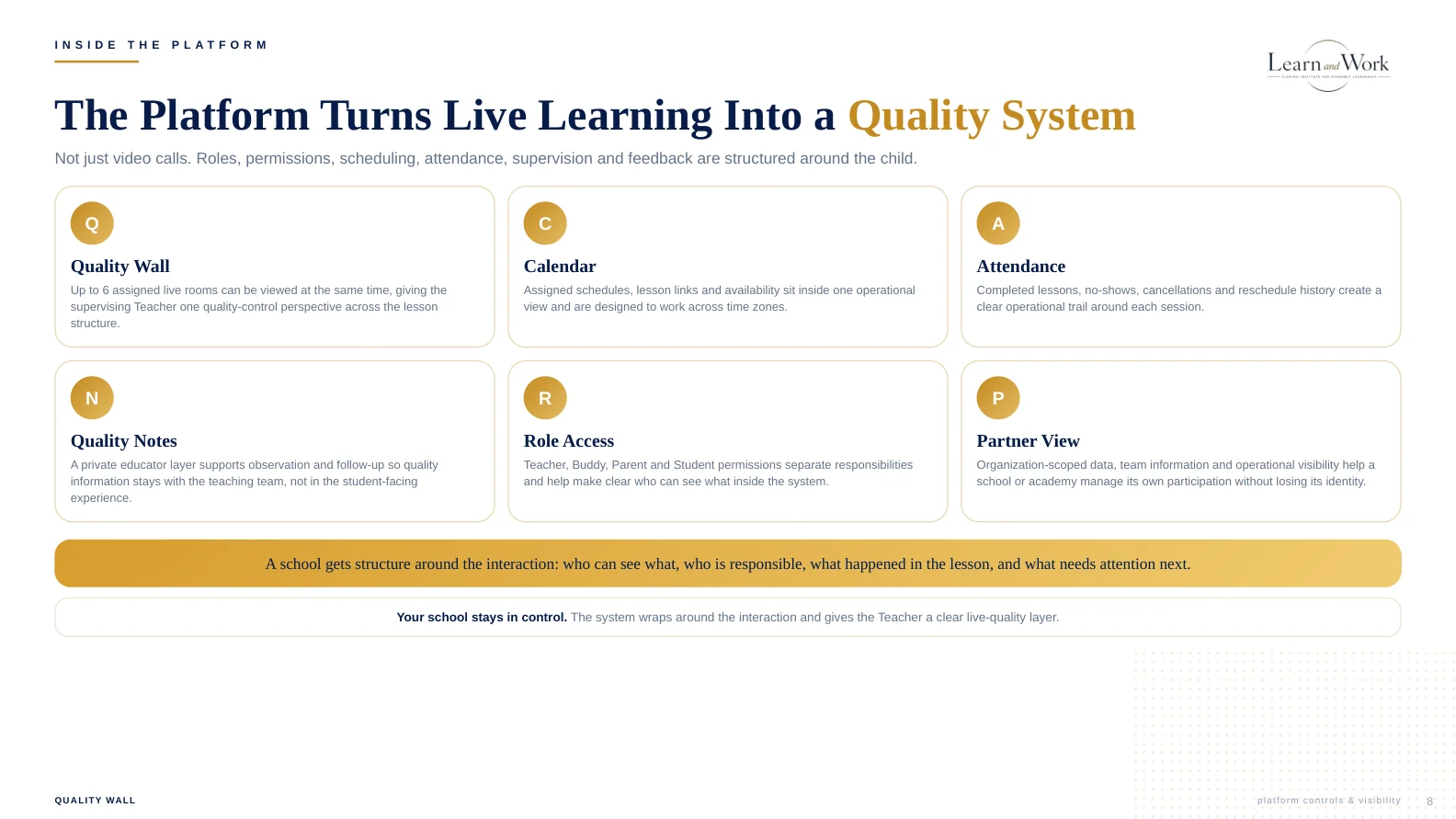
A scalable institutional program needs calendars, time-zone handling, role-based access, assigned Teachers and Buddies, attendance, quality supervision, communication and reporting.
That is where Learn & Work can contribute: not by replacing the public institution, but by providing a common operational layer around direct human exchange.
Platform is the infrastructure. People are the relationship.
A public exchange can connect education with a wider institutional network.
The strongest model is an ecosystem in which education, workforce and public institutions each contribute what they already do best.
- Public and private K–12 schools
- School districts and education authorities
- Municipalities and city education departments
- State / regional education bodies
- National ministries or agencies
- Colleges and universities
- Teacher-training institutions
- Career and technical education providers
- Workforce-development agencies
- Chambers of commerce
- Employers and employer associations
- Libraries and community learning centers
- Nonprofit and youth organizations
- Foundations and philanthropic partners
- International education organizations
- Cultural institutes and exchange bodies
- Public innovation labs
- Research institutions
A framework available for institutional discussion. Any official public designation would require formal adoption by the relevant authority.
Learn & Work Florida Institute for Academic Leadership can present the educational model, curriculum, digital supervision infrastructure, Partner framework and pilot design to public institutions. Any designation as an official exchange, publicly funded program or government initiative would require the relevant authority’s formal approval, agreement and applicable legal process.
Partner Schools help students understand the United States through the people who experience its education every day.
For Partner Schools, Learn & Work proposes recurring international communication with students who are preparing for higher education, international study and early professional life. The aim is to create a structured exchange where students can ask, listen, compare perspectives, present ideas and understand how another education system feels from inside the classroom.
Higher-education awareness
Older learners can discuss study habits, presentations, campus expectations, teamwork, communication and the transition toward college or university.
Professional exchange
Educators can compare classroom approaches, communication expectations, student participation and the practical challenges of preparing young people for the next stage of education.
Institutional perspective
Schools can help explain educational culture, community life, pathways into higher education and the context surrounding students, without turning the exchange into admissions advice.
Structure around the dialogue
We provide the program framework, scheduling logic, role clarity, supervision model and communication structure so the relationship can become recurring rather than occasional.
We invite Partner Schools to contribute, not simply participate.
We hope schools will help us choose useful themes, nominate educators and student groups, shape class-to-class questions and tell us what international learners should understand about education in the United States. The exchange becomes more valuable when schools bring their own knowledge, people and culture into it.
- Preparing for college and university study
- How students communicate with teachers
- Presentations, teamwork and academic discussion
- School culture, clubs, leadership and community life
- Choosing fields of study and exploring careers
- International communication and cultural perspective
Local classroom. International team. One live session.
In the EU school format, up to 30 learners stay physically in their school classroom with at least one local Teacher present. A Buddy and Master Quality Teacher can work on-site from a Partner school / college hub or join online from another location, while remaining in the same live lesson and supervision structure.
Teacher stays in the room
At least one local Teacher is physically present with the class and remains the local educational authority.
Buddy + quality supervision can travel digitally
The Buddy and Master Quality Teacher may be together at a college / school hub or work remotely, with the same live contact and defined roles.
Transatlantic scheduling
South Florida is typically six hours behind Central Europe: 8:00 AM Florida is about 2:00 PM Central Europe, and 3:00 PM Florida is about 9:00 PM. Seasonal clock-change weeks can shift this by one hour.
Florida mornings can meet European classrooms and after-school learners.
For South Florida / Central Europe, the usual difference is six hours. A practical school-partnership window such as 8:00–11:00 AM Florida aligns approximately with 2:00–5:00 PM Central Europe. Supervised individual sessions can extend toward 3:00 PM Florida / 9:00 PM Central Europe. The scheduling system should use time zones directly because daylight-saving changeovers temporarily alter the difference.
School window
Use a focused 3–5 hour Florida-morning block for European school or institutional sessions, depending on each Partner timetable.
Individual window
A wider Florida daytime block can align with European after-school hours, increasing scheduling flexibility for supervised individual sessions.
Student availability
College schedules vary, but morning availability can create a useful cross-Atlantic fit. Any participation hours must remain compatible with academic commitments, Partner policy, work authorization and applicable law.
International educational dialogue should not stop at one subject.
A school-to-school exchange can connect art teachers with art teachers, mathematics educators with mathematics educators, coaches with school-based educators, and multidisciplinary faculty around communication, pedagogy and student readiness. Learn & Work can provide the communication framework while participating institutions shape the academic content of the exchange.
Begin with one classroom connection. Build only what earns the right to grow.
For ministries, cities, regions, school systems, universities and public institutions interested in a structured international education and youth-development pilot.