More live speaking turns.
Children can know English and still need more opportunities to use it in live conversation, explanation, discussion and presentation.
The strongest long-term investment is still an investment in a child. That is why we built a model that serves the full educational ecosystem: families seeking real progress, teachers looking for meaningful professional pathways, schools expanding global learning opportunities, and investors who understand that lasting value is created where educational need is clear and execution is disciplined.
Learn & Work Florida Institute for Academic Leadership brings together structured curriculum, trained adult Buddies, qualified Teachers, school-based implementation, and measurable communication growth within one operating system designed for modern education.
The operating model includes a purpose-built curriculum, CEFR-referenced language progression and CPALMS-informed academic communication architecture.
The curriculum is prepared specifically for live international communication, from early speaking confidence through academic, research and leadership communication.
CEFR is used as an international reference point for language development and communication expectations.
CPALMS standards resources inform age-appropriate academic language, literacy and communication design.
Learn & Work Florida is building one educational ecosystem around needs that are usually treated separately: child communication, teacher quality, young-adult experience and school access to international speaking practice.
Our model is not based on replacing educators with technology. It is based on using technology to organize people, roles, schedules and quality so that live human communication can happen more often and with clearer oversight.
Children can know English and still need more opportunities to use it in live conversation, explanation, discussion and presentation.
The Teacher supervises, evaluates, protects quality and makes educational decisions while the system expands the number of conversations that can happen.
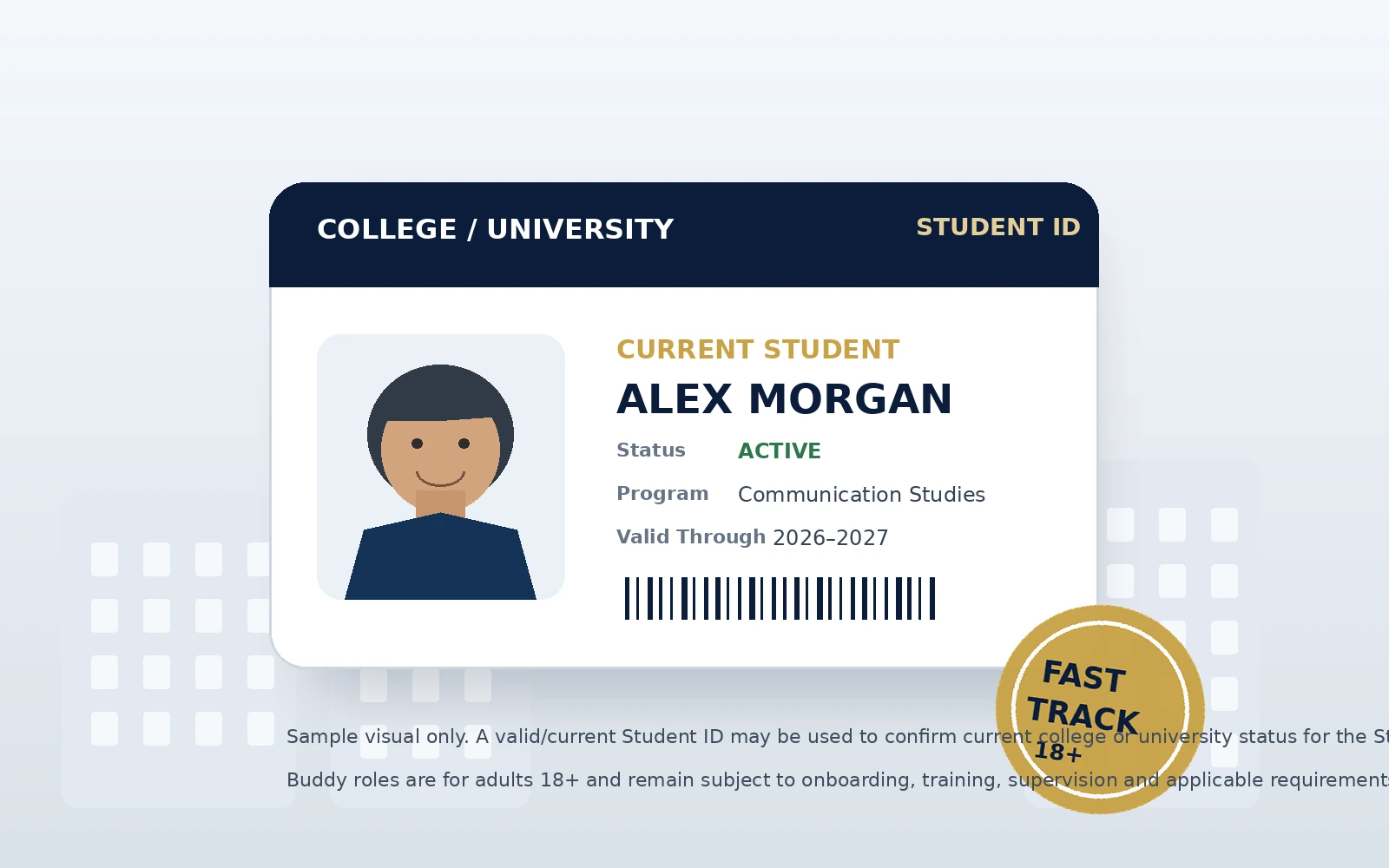
Adults 18+ can enter supervised Buddy pathways. Current college and university students may use the Student Fast-Track with a valid Student ID.
Partner schools can connect their own students, educators and approved Buddies to a shared curriculum, scheduling layer and live quality framework.
The investor conversation starts with what exists today, what is being activated, what still needs proof and what can scale only when quality and demand justify it.
Age pathways for 4–17, structured lesson flow, Teacher Notes, Care Notes, Quality Notes, Buddy scenarios and speaking-centered progression.
Teacher remains the academic authority. The Buddy expands live speaking opportunities under defined role boundaries and supervision.
Calendar, availability, role-based access, lesson views, attendance, feedback, speaking summaries and the Quality Wall.
Partners can manage their own students, Teachers, Buddies, schedules and assignments while participating in the wider network.
Eligible current college and university students can enter a faster onboarding path. Non-college Buddy candidates can be routed to available Partner training units.
The family-facing environment connects enrollment, live learning, Teacher feedback, progress and the daily student experience.
“When the hens start clucking, sell” is a metaphor for timing, not an investment rule. The point is not to chase noise. The point is to ask whether a meaningful problem was identified early enough for a disciplined system to be built around it.
Children may know more English than they comfortably use. Schools want more live international communication. Young adults need credible supervised experience. Teachers need structures that extend their reach without reducing professional authority.
Curriculum, lesson methodology, role boundaries, Teacher supervision, Partner workflows, Student Fast-Track, local training pathways and platform infrastructure are designed to work as one system.
Adoption, retention, Partner activation, quality, utilization and unit economics must be measured. We prefer operating evidence over inflated projections.
Families and schools do not simply consume a lesson. In the Learn & Work model, demand for structured communication can also create supervised experience for adults 18+, including college students and local Buddy candidates.
A family chooses the program for a child. A qualified Teacher protects quality. A trained young adult gains supervised experience. A Partner school can become a local training hub. Over time, communication, reliability, mentoring and leadership capacity can circulate back into the community.
The program grows only if the people around it grow too.
An investor page should not hide the questions that still matter. The discussion is about execution, adoption, quality, partner activation, unit economics, compliance, retention and whether the model can scale without losing the human standard.
Recruitment, onboarding, Partner readiness and Teacher quality have to work in practice, not just on a diagram.
Growth depends on observed customer behavior, not assumptions. Pilots, conversion, retention and repeat use matter.
The model only matters if live supervision, small-group interaction and role clarity survive scale.
Commercial terms, staffing costs, partner share, acquisition cost and utilization all require disciplined measurement.
Roles, qualifications, safeguarding, verification and school requirements differ across markets and must be handled accordingly.
We prefer measured evidence over inflated claims. Program, customer and operating data should determine what deserves to scale next.
In the EU school format, up to 30 learners stay physically in their school classroom with at least one local Teacher present. A Buddy and Master Quality Teacher can work on-site from a Partner school / college hub or join online from another location, while remaining in the same live lesson and supervision structure.
At least one local Teacher is physically present with the class and remains the local educational authority.
The Buddy and Master Quality Teacher may be together at a college / school hub or work remotely, with the same live contact and defined roles.
South Florida is typically six hours behind Central Europe: 8:00 AM Florida is about 2:00 PM Central Europe, and 3:00 PM Florida is about 9:00 PM. Seasonal clock-change weeks can shift this by one hour.
We can share stage-appropriate materials for a serious conversation about the program, Partner model, execution plan, operating assumptions, current proof points and the questions that still require validation.