Learning Partner
Use Shining Speech™ with your own learners while keeping local educators and institutional context at the center.
Learn & Work Florida is designed for schools, colleges, universities, municipalities, foundations, workforce organizations and public bodies that want to explore a defined role without giving up institutional identity, local authority or existing responsibilities.
The curriculum is purpose-designed for international classroom use, informed by day-to-day school operations, CEFR language progression and CPALMS standards resources.
The curriculum is prepared specifically for live international communication, from early speaking confidence through academic, research and leadership communication.
CEFR is used as an international reference point for language development and communication expectations.
CPALMS standards resources inform age-appropriate academic language, literacy and communication design.
An institution can begin with the role it already performs well: education, mentoring, training, research, workforce access, community outreach or international connection. Learn & Work provides a common framework around those strengths.
Use Shining Speech™ with your own learners while keeping local educators and institutional context at the center.
Train eligible Buddies 18+ and support supervised local development under qualified Teacher oversight.
Connect educators, curriculum conversations, observation and structured international classroom activity.
Host a defined pilot with agreed scope, governance, safeguarding, evaluation and reporting.
Help translate communication, teamwork and leadership practice into internships, entry roles and career pathways.
Support responsible evaluation, educational inquiry and evidence-building around communication and participation.
Help reach families, multilingual learners and young adults through trusted local infrastructure.
Connect classrooms, Teachers, schools and institutions across borders through structured live communication.
The model can be discussed at different scales. The governance, legal structure and implementation route should match the institution involved.
The institutional pathway is intentionally staged so that a local pilot can exist before a district, city or cross-border network is asked to adopt anything larger.
Define population, purpose, staffing, local responsibilities and what the institution wants to learn.
Begin with a manageable cohort, Teacher team or local training unit.
Look at participation, operational quality, staffing, feedback and implementation friction.
Add more classrooms, Teachers, Buddies or partner organizations where the pilot supports it.
Build school-to-school, institution-to-institution or public-system cooperation with formal agreements where needed.
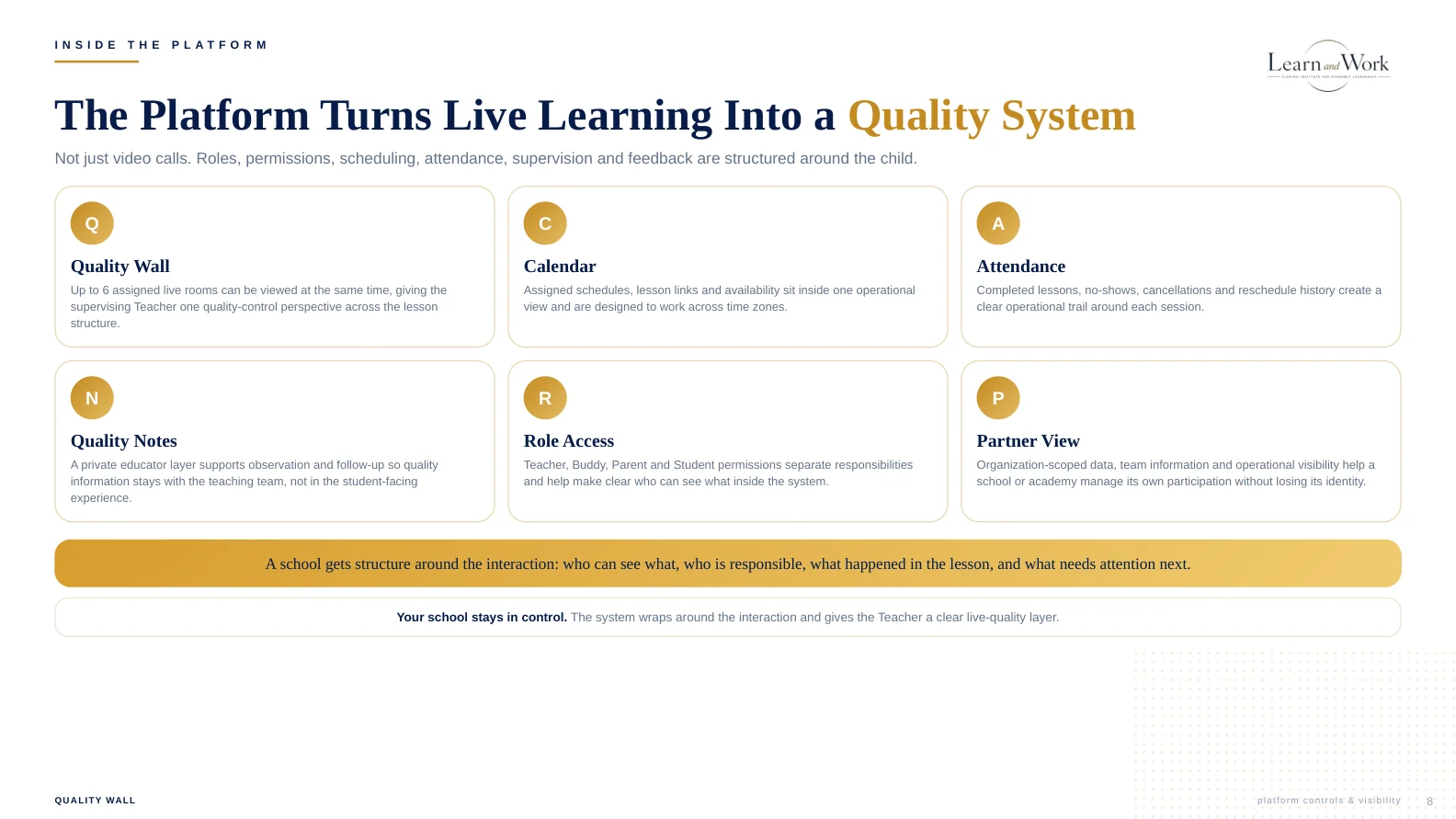
A scalable partnership needs clarity around who belongs to which organization, who can see which learner, who is available, who is assigned, what happened, what needs follow-up and who remains accountable.
The Learn & Work platform can support role-based access, calendars, lesson assignment, attendance, quality notes, communication, Partner visibility and Student Speaking Summary.
The platform is the infrastructure. The institution remains the institution.
Current college and university students may qualify for the Student Fast-Track using a valid/current Student ID where status verification is required. Eligible adults 18+ who are not in college can follow the General Buddy Pathway and may be routed to the nearest available Partner training unit.
If your institution becomes an approved local training Partner, orientation, observation and supervised development can sit closer to the community you already serve.
If the answer is yes and local onboarding is active, the pathway may be faster because part of the training and observation can happen through the institution itself.
Any larger implementation should define safeguarding, data protection, accessibility, procurement, funding, evaluation, local curriculum authority, staff responsibilities and escalation before scale.
Defined roles, Buddy 18+, Teacher authority, approved channels and child-protection expectations.
Institutional access, consent and cross-border data practices must follow applicable law and policy.
The program supplements local education and does not replace the institution’s academic or public authority.
Technology, disability access, language needs and inclusion requirements should be built into implementation.
Partners should agree what success means and what evidence will be reviewed before launch.
MOUs, contracts, public approvals or procurement processes should match the scale and status of the partnership.
For Partner Schools, Learn & Work proposes recurring international communication with students who are preparing for higher education, international study and early professional life. The aim is to create a structured exchange where students can ask, listen, compare perspectives, present ideas and understand how another education system feels from inside the classroom.
Older learners can discuss study habits, presentations, campus expectations, teamwork, communication and the transition toward college or university.
Educators can compare classroom approaches, communication expectations, student participation and the practical challenges of preparing young people for the next stage of education.
Schools can help explain educational culture, community life, pathways into higher education and the context surrounding students, without turning the exchange into admissions advice.
We provide the program framework, scheduling logic, role clarity, supervision model and communication structure so the relationship can become recurring rather than occasional.
We hope schools will help us choose useful themes, nominate educators and student groups, shape class-to-class questions and tell us what international learners should understand about education in the United States. The exchange becomes more valuable when schools bring their own knowledge, people and culture into it.
In the EU school format, up to 30 learners stay physically in their school classroom with at least one local Teacher present. A Buddy and Master Quality Teacher can work on-site from a Partner school / college hub or join online from another location, while remaining in the same live lesson and supervision structure.
At least one local Teacher is physically present with the class and remains the local educational authority.
The Buddy and Master Quality Teacher may be together at a college / school hub or work remotely, with the same live contact and defined roles.
South Florida is typically six hours behind Central Europe: 8:00 AM Florida is about 2:00 PM Central Europe, and 3:00 PM Florida is about 9:00 PM. Seasonal clock-change weeks can shift this by one hour.
For South Florida / Central Europe, the usual difference is six hours. A practical school-partnership window such as 8:00–11:00 AM Florida aligns approximately with 2:00–5:00 PM Central Europe. Supervised individual sessions can extend toward 3:00 PM Florida / 9:00 PM Central Europe. The scheduling system should use time zones directly because daylight-saving changeovers temporarily alter the difference.
Use a focused 3–5 hour Florida-morning block for European school or institutional sessions, depending on each Partner timetable.
A wider Florida daytime block can align with European after-school hours, increasing scheduling flexibility for supervised individual sessions.
College schedules vary, but morning availability can create a useful cross-Atlantic fit. Any participation hours must remain compatible with academic commitments, Partner policy, work authorization and applicable law.
Institutions may involve licensed educators from art, mathematics, STEM, literacy, public speaking, performing arts, PE and other disciplines in Master Teacher development, provided the applicable role requirements are met. The objective is a broader educational conversation, not a narrow English-only staffing model.
Bring subject knowledge into communication, presentation and reasoning practice.
Faculty can share classroom approaches, questions and professional context across institutions.
Licensed educators can help supervise and develop Buddy teams within the Partner structure.
For schools, colleges, universities, public bodies, foundations, workforce organizations and community institutions interested in education, local training, youth development or international exchange.