Find a voice
Practice speaking, listening, reasoning, presenting and participating in a structured human environment.
When a child learns to speak with confidence, a young adult learns to mentor responsibly, a Teacher develops future educators, a school becomes a local talent hub and an employer meets people who already know how to communicate, education begins to create value far beyond one lesson.
A purpose-built curriculum connects day-to-day school practice with CEFR language references and CPALMS-informed academic communication.
The curriculum is prepared specifically for live international communication, from early speaking confidence through academic, research and leadership communication.
CEFR is used as an international reference point for language development and communication expectations.
CPALMS standards resources inform age-appropriate academic language, literacy and communication design.
Shining Speech™ begins with the learner, but the operating model can create a wider chain of development around the learner. The goal is not to turn education into recruitment. It is to make communication, mentoring, leadership and defined responsibility visible earlier.
Practice speaking, listening, reasoning, presenting and participating in a structured human environment.
A family choosing the program supports a model that can also create supervised development opportunities for young adults around the community.
Buddies 18+ can develop communication, responsibility, mentoring habits, international awareness and professional presence under supervision.
The Teacher remains the academic authority while also mentoring Buddies and helping future educators learn professional judgment.
Schools, colleges, universities and organizations can train people locally, connect internationally and keep their own identity at the center.
Employers benefit when emerging talent arrives with evidence of communication, teamwork, reliability, reflection and experience working with people.
The child enters a structured speaking pathway.
Teachers and approved Buddies work inside defined responsibilities.
Communication becomes practiced behavior, not a résumé adjective.
Employers can meet emerging talent with more context than a degree title alone.
Experience can return through mentoring, education, work and local leadership.
Technical knowledge matters. So does the ability to explain an idea, work with people, ask a useful question, receive feedback, adapt and take responsibility. Learn & Work creates a setting in which those behaviors can be practiced before the first full-time role.
Speaking clearly, listening actively, explaining ideas and adapting language to another person.
Working within defined roles, respecting supervision, coordinating with others and following through.
Learning that leadership begins with responsibility, preparation and helping another person succeed.
Moving beyond answers toward reasons, evidence, questions, judgment and explanation.
Interacting across cultures and time zones while learning to communicate with context and respect.
Showing up prepared, following a framework, documenting activity and responding to feedback.
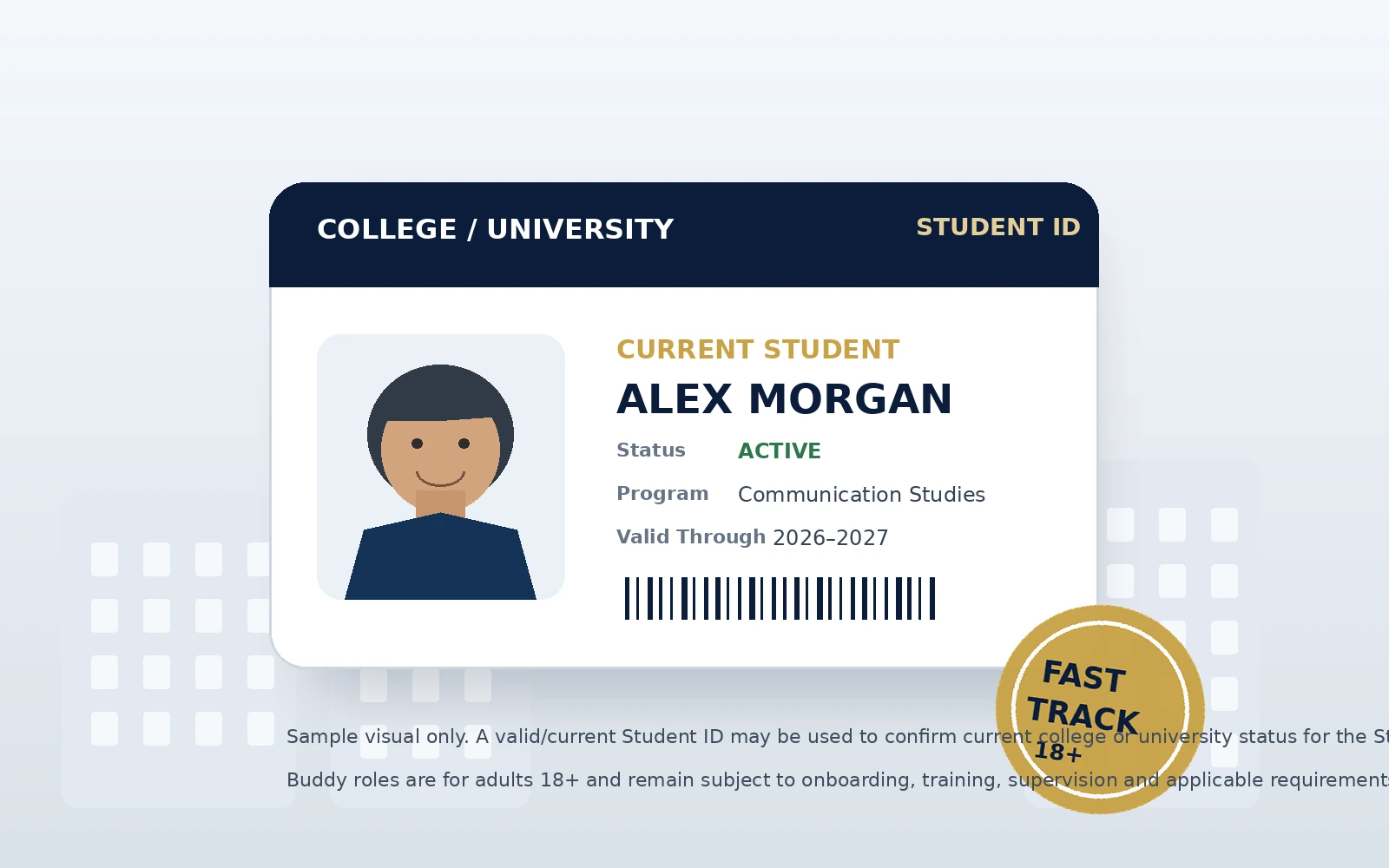
College / University Student Fast-Track: qualifying current students may use a valid/current Student ID for the faster internal status-verification pathway where available.
General Buddy Pathway: an eligible adult 18+ who is not currently in college can be routed to the nearest available Learn & Work Partner training unit for onboarding, observation and training.
Ask your school: “Are we already a Learn & Work Partner?” If your school or college is an active training Partner, part of the pathway can happen locally and the route to supervised practice may be faster.
The most useful model is circular: schools help young people develop, young people gain responsibility, employers and institutions open the next door, and experienced people return as mentors, Teachers, leaders or community contributors.
Identify students, educators and young adults ready for a structured development pathway.
Training, international communication, supervision, materials, roles and evidence of participation.
Internships, entry roles, further study, mentoring, education, service and local leadership can become the next stage.
Each participant can contribute a different layer without being asked to become something it is not.
In the EU school format, up to 30 learners stay physically in their school classroom with at least one local Teacher present. A Buddy and Master Quality Teacher can work on-site from a Partner school / college hub or join online from another location, while remaining in the same live lesson and supervision structure.
At least one local Teacher is physically present with the class and remains the local educational authority.
The Buddy and Master Quality Teacher may be together at a college / school hub or work remotely, with the same live contact and defined roles.
South Florida is typically six hours behind Central Europe: 8:00 AM Florida is about 2:00 PM Central Europe, and 3:00 PM Florida is about 9:00 PM. Seasonal clock-change weeks can shift this by one hour.
For South Florida / Central Europe, the usual difference is six hours. A practical school-partnership window such as 8:00–11:00 AM Florida aligns approximately with 2:00–5:00 PM Central Europe. Supervised individual sessions can extend toward 3:00 PM Florida / 9:00 PM Central Europe. The scheduling system should use time zones directly because daylight-saving changeovers temporarily alter the difference.
Use a focused 3–5 hour Florida-morning block for European school or institutional sessions, depending on each Partner timetable.
A wider Florida daytime block can align with European after-school hours, increasing scheduling flexibility for supervised individual sessions.
College schedules vary, but morning availability can create a useful cross-Atlantic fit. Any participation hours must remain compatible with academic commitments, Partner policy, work authorization and applicable law.
For organizations interested in community impact, youth development, workforce readiness, education partnerships or local training capacity.